
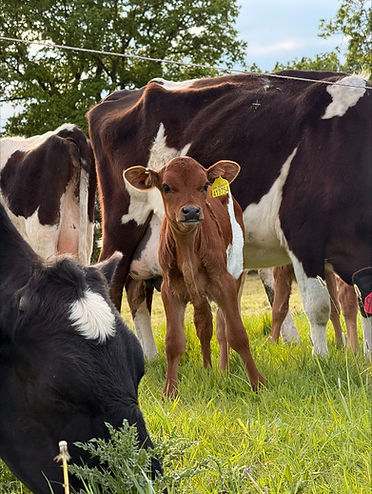

What is a Cow and Calf System?
To produce milk, a cow must have a calf every year. In modern dairy farming, this calf is normally separated from its mother almost immediately after birth. This allows a farmer to monitor the calf and ensure that it drinks enough milk, grows well, and remains healthy. Naturally, farmers do this because they also like to take good care of their animals and the calves and cows both do well on this system. At Calf First, we work with farmers who do things a little differently where calves are allowed to stay with their mothers for a period of 3-5 months after birth until when they are weaned from milk. This is called a 'Cow and Calf' System.
How does it work?
Our suppliers split their herd up to groups of 10 cows that all have similar calving dates. The cows give birth to their calves and remain in the same group. The cows are not milked in the parlour during the period when they are feeding their calves. The calves are kept with their mothers until they are ready to be weaned. This is typically between 3 and 5 months. At this stage the cows are moved into the main herd where they are milked through the parlour. The heifer calves go into larger groups where they are reared to be future dairy cows. The beef calves are reared on farm for a minimum of 2 years before being sold for beef.
Healthier calves:
Fewer illnesses (such as diarrhea and pneumonia)
More active calves
Improved udder health of the mother cow
Increased disease resistance of the calf
Easier calving due to lower stress
Better social development:
More sociable calves that are less afraid
Calves also learn to provide maternal care for the future.
Less stereotypical, compulsive behaviour (such as sucking on other calves)
Early separation leads to stress for calf and cow
What are the Benefits?